
Category Archives: Routine Testing

IMPORTANT REPORT UPGRADES – Particle Count Reporting
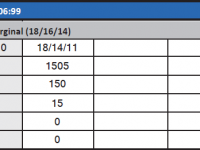
IMPORTANT REPORT UPGRADES Particle Count Reporting TestOil has improved our method for reporting particle count limits to make it easier to review and interpret oil analysis test results TestOil has upgraded our oil analysis reports to include the ISO code limits for both the Pore Blockage and the Optical Particle Count tests. The limits will…
Read more

Understanding Particle Counting Methods

Understanding Particle Counting Methods Particle counting is considered by many to be one of the most important test for used oil analysis. Many problems can be quickly and easily identified by monitoring the number and size-distribution of particles in an oil sample. The ISO Code is the most common unit of reporting the number of…
Read more

Know the Proper Base Number of Your Oil

Know the Proper Base Number of Your Oil The base number (BN) is a property that is more associated with engine oils rather than industrial oils. It can be defined as the oil’s ability to neutralize acids that are produced during use. The higher the base number in the engine oil, the more acid it…
Read more

Testing For Water

Testing For Water Water is one of the most destructive contaminants faced by industrial maintenance departments.  Studies have shown that water present at any level can reduce bearing life from 10 to 100 times.  While the overall tolerance for water varies from machine to machine, a good general alarm limit for water contamination is 0.05%…
Read more

Water In Oil, What’s the Big Deal?

Water In Oil, What's the Big Deal? Water in lubricating oil has been a point of keen debate as long as oil analysis has been used to monitor equipment and lubricant condition. How much is too much? Where does it come from? Does it really hurt equipment? What form of water is of concern? How…
Read more

Analyzing Foaming Tendency: Foam Test

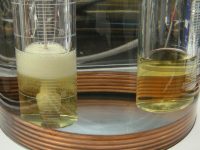
Analyzing Foaming Tendency: Foam Test The Foam Test measures the foaming tendency of a lubricant. According to this test, also referred to as ASTM D892, the tendency of oils to foam can be a serious problem in systems such as high-speed gearing, high-volume pumping, and splash lubrication. Inadequate lubrication, cavitation, and overflow loss of lubricant…
Read more