
Blog

Can you identify the type of wear?

Can you identify the type of wear? Analytical Ferrography allows analysts to visually examine wear particles present in a sample. A trained analyst visually determines the type and severity of wear deposited onto the substrate by using a high magnification microscope.  The particles are readily identified and classified according to size, shape, and metallurgy. The image…
Read more

Measuring Varnish Potential in Lube Oil

Measuring Varnish Potential in Lube Oil Lubricating oil in gas turbines and hydraulic systems is unfortunately subject to the ravages of varnish. It is well-documented that varnish is an insoluble contaminant comprised of oil degradation by-products and sometimes depleted additive molecules. It is generally caused by some type of thermal (heat-related) stress placed on the…
Read more

Can you identify this type of wear?

Can you identify this type of wear? Analytical Ferrography allows analysts to visually examine wear particles present in a sample. A trained analyst visually determines the type and severity of wear deposited onto the substrate by using a high magnification microscope.  The particles are readily identified and classified according to size, shape, and metallurgy. The…
Read more

Water In Oil, What’s the Big Deal?

Water In Oil, What's the Big Deal? Water in lubricating oil has been a point of keen debate as long as oil analysis has been used to monitor equipment and lubricant condition. How much is too much? Where does it come from? Does it really hurt equipment? What form of water is of concern? How…
Read more

New Base Number Test Procedure

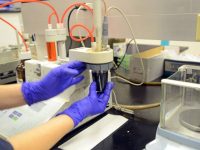
New Base Number Test Procedure Technical Bulletin Posted January 2013 TESTOIL has implemented a new testing procedure for measuring Base Number (TBN) using FTIR. Test Revisions Traditionally, Base Number has been measured with a potentiometric titrator using large volumes of hazardous solvents. We have spent considerable time working with Fourier Infrared Spectroscopy (FTIR) experts and…
Read more

New Membrane Patch Colorimetry Test Procedure

New MPC Test Procedure Technical Bulletin New Membrane Patch Colorimetry Test Procedure TESTOIL is modifying its Membrane Patch Colorimetry (MPC) test procedure to a newly proposed ASTM standard.   Test Revisions The proposed ASTM standard for the Membrane Patch Colorimetry test requires a sample to be heated for a period of 24 hours at the lab to allow any insoluble…
Read more