

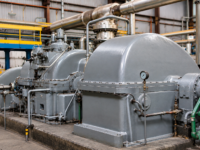
Steam turbines operate under demanding conditions where lubricant performance directly influences bearing reliability, control-system responsiveness, and equipment availability. Because turbine oils often remain in service for years, monitoring their chemical stability and contamination levels is essential to preventing unplanned outages.
An effective oil analysis program identifies developing failure mechanisms and provides actionable data for maintenance decisions. Following are standard test packages.
Annual and Semi-Annual Varnish Package
This is a comprehensive assessment of lubricant condition, oxidation stability, contamination, and varnish formation potential. It helps identify emerging problems before they compromise equipment performance. Tests include:
- FTIR (Fourier Transform Infrared Spectroscopy): Identifies chemical changes associated with oxidation, contamination, and lubricant degradation.
- Particle Count: Measures solid contamination that contributes to abrasive wear and can interfere with sensitive hydraulic controls.
- Karl Fischer Water Analysis: Quantifies moisture contamination that can accelerate oxidation, promote corrosion, and reduce bearing reliability.
- Acid Number (AN): Tracks acidic oxidation byproducts that can indicate progressive lubricant degradation and potential corrosion risks.
- RULER (Remaining Useful Life Evaluation Routine): Measures remaining antioxidant levels to assess lubricant degradation and estimate remaining oxidation protection.
- Membrane Patch Colorimetry (MPC): Assesses varnish potential by measuring deposits associated with insoluble degradation products.
- Ultracentrifuge: Separates and evaluates insoluble contaminants and degradation products that may contribute to varnish and deposit formation.
- Optical Particle Count: Measures solid contamination that contributes to abrasive wear and can interfere with sensitive hydraulic controls.
Annual Turbine Analysis
The Annual Turbine Analysis test package provides a comprehensive assessment of turbine oil condition, contamination, oxidation stability, and remaining useful life, helping to identify emerging problems before they compromise equipment reliability and performance. Tests include:
- Viscosity at 40°C: Detects changes associated with oxidation, contamination, or incorrect lubricant addition that may compromise film thickness and lubrication performance.
- Demulsibility: Evaluates the oil's ability to separate from water, helping to identify conditions that could compromise lubrication and accelerate corrosion.
- FTIR (Fourier Transform Infrared Spectroscopy): Identifies chemical changes associated with oxidation, contamination, and lubricant degradation.
- ICP Spectroscopy: Measures wear metals, contaminants, and additive elements to help identify equipment wear, contamination, and changes in lubricant composition.
- Particle Count: Measures solid contamination that contributes to abrasive wear and can interfere with sensitive hydraulic controls.
- Karl Fischer Water Analysis: Quantifies moisture contamination that can accelerate oxidation, promote corrosion, and reduce bearing reliability.
- Acid Number (AN): Tracks acidic oxidation byproducts that can indicate progressive lubricant degradation and potential corrosion risks.
- Rotating Pressure Vessel Oxidation Test (RPVOT): Evaluates remaining oxidation resistance, supporting decisions about lubricant service life.
- Foam: Evaluates the oil's tendency to form foam and its ability to dissipate it, helping identify conditions that could interfere with effective lubrication.
- Color: Monitors changes in oil appearance that may indicate oxidation, contamination, or other forms of lubricant degradation.
- Rust: Evaluates the oil's ability to protect metal surfaces from rust formation in the presence of water.
- RULER (Remaining Useful Life Evaluation Routine): Measures remaining antioxidant levels to assess lubricant degradation and estimate remaining oxidation protection.
- Membrane Patch Colorimetry (MPC): Assesses varnish potential by measuring deposits associated with insoluble degradation products.
- Ultracentrifuge: Separates and evaluates insoluble contaminants and degradation products that may contribute to varnish and deposit formation.
Turning Test Results into Reliability Decisions
Individual test results provide useful information, but trending multiple parameters reveals more meaningful patterns. For example, declining oxidation resistance combined with increasing acid number and MPC values may indicate advancing lubricant degradation before operational symptoms appear. Similarly, increasing particle counts accompanied by elevated wear metals can distinguish contamination problems from developing mechanical wear.
Eurofins TestOil lets industrial operators establish effective monitoring programs through comprehensive lab testing and expert interpretation. By integrating routine analysis with condition-based maintenance strategies, facilities can extend lubricant service life, improve turbine reliability, and reduce the risk of unexpected downtime.
Contact Eurofins TestOil to discuss a testing program tailored to your steam turbines, lubricant, and operating environment. Visit https://testoil.com/trustplus-oil-analysis/start-testing-now/; call 216-251-2510; or email testoil-sales@et.eurofinsus.com.
With more than 30 years of experience in the oil analysis industry, Eurofins TestOil focuses exclusively on assisting industrial facilities with reducing maintenance costs and avoiding unexpected downtime through oil and fuel analysis program implementation. As industry experts in diagnosing oil-related issues in equipment such as turbines, hydraulics, gearboxes, pumps, compressors and diesel generators, Eurofins TestOil provides customers with same-day turnaround on routine oil analysis testing.
About Eurofins – the global leader in bio-analysis
Eurofins is Testing for Life. Eurofins is the global leader in food, environment, pharmaceutical and cosmetic product testing, and in discovery pharmacology, forensics, advanced material sciences and agroscience Contract Research services. Eurofins is also a market leader in certain testing and laboratory services for genomics, and in the support of clinical studies, as well as in BioPharma Contract Development and Manufacturing. The Group also has a rapidly developing presence in highly specialised and molecular clinical diagnostic testing and in-vitro diagnostic products.
With over 61,000 staff across a network of 940 laboratories in 59 countries, Eurofins’ companies offer a portfolio of over 200,000 analytical methods. Eurofins Shares are listed on Euronext Paris Stock Exchange.
